

Electron Configuration Ending In S2d2
5.17: Electron Configurations and the Periodic Table
- Page ID
- 49338

The unremarkably used long form of the periodic table is designed to emphasize electron configurations. Since it is the outermost (valence) electrons which are primarily involved in chemical interactions between atoms, the last electron added to an cantlet in the building-up process is of far more interest to a chemist than the offset. This last electron is called the distinguishing electron because it distinguishes an atom from the one immediately preceding information technology in the periodic table. The type of subshell (s, p, d, f)into which the distinguishing electron is placed is very closely related to the chemic behavior of an element and gives rise to the classification shown by the color-coding on the periodic table seen here. The representative elements are those in which the distinguishing electron enter ans or p subshell. Most of the elements whose chemical science and valence we have discussed then far autumn into this category. Many of the chemical properties of the representative elements tin can be explained on the basis of Lewis diagrams. That is, the valences of the representative elements may be predicted on the ground of the number of valence electrons they have, or from the number of electrons that would have to be added in order to attain the aforementioned electron configuration every bit an atom of a noble gas. For representative elements the number of valence electrons is the same as the periodic group number, and the number needed to match the adjacent noble-gas configuration is viii minus the grouping number. This agrees with the valence rules derived from the periodic table, and results in formulas for chlorides of the showtime dozen elements that testify the periodic variation of valence.
| Element | Atomic Weight | Hydrogen Compounds | Oxygen Compounds | Chlorine Compounds |
|---|---|---|---|---|
| Hydrogen | 1.01 | H2 | H2O, H2Otwo | HCl |
| Helium | iv.00 | None formed | None formed | None formed |
| Lithium | half-dozen.94 | LiH | LitwoO, LitwoO2 | LiCl |
| Beryllium | 9.01 | BeHtwo | BeO | BeCl2 |
| Boron | x.81 | BtwoH6 | B2O3 | BCl3 |
| Carbon | 12.01 | CHfour , C2H6, C3Height | COii , CO, C2O3 | CCl4 , CiiClsix |
| Nitrogen | 14.01 | NH3 , NiiH4, HN3 | NiiO, NO, NO2, N2O5 | NCl3 |
| Oxygen | sixteen.00 | H2O, HiiO2 | O2 , O3 | <Cl2O, ClO2, CltwoOseven |
| Fluorine | 19.00 | HF | OF2 , O2F2 | ClF, ClF3, ClF5 |
| Neon | 20.18 | None formed | None formed | None formed |
| Sodium | 22.99 | NaH | Na2O, NaiiO2 | NaCl |
| Magnesium | 24.31 | MgH2 | MgO | MgCl2 |
The first three horizontal rows or periods in the mod periodic table consist entirely of representative elements. In the first period the distinguishing electrons for H and He are in the 1due south subshell. Beyond the second period Li and Be have distinguishing electrons in the 2southward subshell, and electrons are being added to the twop subshell in the atoms from B to Ne. In the third period the 3s subshell is filling for Na and Mg, and therefore Al, Si, P, South, Cl, and Ar. As a general rule, in the case of the representative elements, the distinguishing electron will exist in an ns or np subshell. The value of n, the principal quantum number for the distinguishing electron, can be chop-chop determined by counting down from the pinnacle of the periodic table. For instance, iodine is a representative chemical element in the fifth period. Therefore the distinguishing electron must occupy either the 5s or vp subshell. Since I is on the right side of the table, 5p is the correct option.
When the primary quantum number is iii or more, d-type subshells are also possible. The transition elements or transition metals are those elements whose distinguishing electron is plant in a d orbital. The first examples of transition metals (Sc, Ti, Five, Cr, Mn, Fe, Co, Ni, Cu, Zn) are found in the fourth menstruation even though the distinguishing electron in each case is a threed electron and belongs to the 3rd vanquish. This hiatus results, as we take already seen, because the 4s is lower in energy than the threed. The ivs orbital thus starts to make full upwardly, get-go the 4th period earlier whatever of the 3d orbitals can become occupied.
Figure \(\PageIndex{1}\) compares the probability distributions of a 4s and a iiid electron in a 5 atom. Although the 4s electron cloud lies farther from the nucleus on average than does the 3d cloud, a small portion of the 4s electron density is found very close to the nucleus where it is hardly shielded from the total nuclear charge of +23. It is the very strong attractive force of this small fraction of the total 4south electron density that lowers the energy of the 4south electron below that of the threed.
_and_4s_(color)_Electron_Clouds.jpg?revision=1)
The fact that the 4s electron cloud is more than extensive than the 3d has an important influence on the chemical science of the transition elements. When an atom such every bit V (Figure \(\PageIndex{i}\) ) interacts with some other atom, information technology is the 4s electrons extending farthest from the nucleus which first contact the other atom. Thus the fours electrons are often more pregnant than the 3d in determining valence and the formulas of compounds. The threed electrons are "buried" nether the surfaces of the atoms of the transition metals. Adding one more 3d electron has considerably less result on their chemical properties than adding one more 3south or threep electron did in the case of the representative elements. Hence there is a dull merely steady transition in backdrop from one transition metal to some other. Notice, for example, that except for Sc, all of the transition metals form chlorides, MCl2, where the metal has a valence of two; examples are TiCl2, VCl2, CrCl2, and so on. This can be seen in the table institute at the height of this page. The valence of 2 corresponds with the two 4s valence electrons.
Each of the transition metals also exhibits other valences where one or more of the iiid electrons are also involved. For example, in some compounds V (vanadium) has a valence of 2 (VO, VClii) in others it has a valence of three (Five2O3, VCl3), in still others it has a valence of iv (VO2, VCliv), and in at least one case (V2O5) information technology has a valence of five. The chemistry of the transition metals is more complicated and a wider diverseness of formulas for transition-metal compounds is possible because of this variable valence. In some cases electrons in the d subshells act as valence electrons, while in other cases they practice not. Although the threed electron clouds do not extend further from the nucleus than 3south and 3p (and hence practice not plant another trounce equally the fours electrons do), they are thoroughly shielded from the nuclear accuse and thus ofttimes human activity every bit valence electrons. This Jekyll and Hyde beliefs of 3d electrons makes life more complicated (and ofttimes far more than interesting) for chemists who study the transition elements.
| Z | Element | Configuration |
|---|---|---|
| 1 | H | anes 1 |
| 2 | He | anesouthward 2 |
| iii | Li | [He] twos 1 |
| 4 | Be | [He] iis 2 |
| 5 | B | [He] twodue south 2 2p 1 |
| six | C | [He] iis 2 2p 2 |
| seven | N | [He] 2s 2 2p iii |
| eight | 0 | [He] 2south 2 twop iv |
| 9 | F | [He] twos 2 2p 5 |
| x | Ne | [He] iis 2 2p 6 |
| 11 | Na | [Ne] iiis 1 |
| 12 | Mg | [Ne] 3s 2 |
| 13 | Al | [Ne] iiis two 3p 1 |
| 14 | Si | [Ne]iiisouth ii 3p 2 |
| 15 | P | [Ne] threesouth 2 3p 3 |
| 16 | S | [Ne] 3s two 3p four |
| 17 | Cl | [Ne] 3s 2 3p 5 |
| 18 | Ar | [Ne] 3south 2 3p vi |
| nineteen | K | [Ar] 4southward one |
| 20 | Ca | [Ar] 4south two |
| 21 | Sc | [Ar] iiid 1 fours 2 |
| 22 | Ti | [Ar] 3d 2 ivdue south 2 |
| 23 | 5 | [Ar] iiid 3 4s 2 |
| 24 | Cr | [Ar] 3d 5 4s i |
| 25 | Mn | [Ar] 3d 5 4s two |
| 26 | Fe | [Ar] iiid half dozen 4southward 2 |
| 27 | Co | [Ar] threed seven 4s two |
| 28 | Ni | [Ar] iiid eight ivs 2 |
| 29 | Cu | [Ar] iiid 10 4southward 1 |
| xxx | Zn | [Ar] 3d x 4s 2 |
| 31 | Ga | [Ar] 3d 10 fours two 4p one |
| 32 | Ge | [Ar] threed 10 4southward 2 4p 2 |
| 33 | Every bit | [Ar] 3d 10 4southward 2 4p 3 |
| 34 | Se | [Ar] 3d x 4s ii ivp 4 |
| 35 | Br | [Ar] 3d ten 4s 2 4p 5 |
| 36 | Kr | [Ar] 3d 10 foursouth ii 4p 6 |
| 37 | Rb | [Kr] 5s one |
| 38 | Sr | [Kr] 5due south ii |
| 39 | Y | [Kr] 4d 1 5s two |
| 40 | Zr | [Kr] 4d 2 5due south 2 |
| 41 | Nb | [Kr] 4d four 5south 1 |
| 42 | Mo | [Kr] ivd five 5due south 1 |
| 43 | Tc | [Kr] fourd 5 5south two |
| 44 | Ru | [Kr] 4d 7 vsouth 1 |
| 45 | Rh | [Kr] ivd eight 5s 1 |
| 46 | Pd | [Kr] fourd ten |
| 47 | Ag | [Kr] 4d ten vs 1 |
| 48 | Cd | [Kr] 4d 10 5s ii |
| 49 | In | [Kr] 4d x 5due south 2 5p 1 |
| 50 | Sn | [Kr] 4d 10 5south two 5p ii |
| 51 | Sb | [Kr] 4d x 5due south ii 5p iii |
| 52 | Te | [Kr] 4d 10 5s 2 5p 4 |
| 53 | I | [Kr] 4d 10 5due south 2 vp five |
| 54 | Xe | [Kr] ivd ten 5southward 2 5p half dozen |
| 55 | Cs | [Xe] 6s i |
| 56 | Ba | [Xe] 6s 2 |
| 57 | La | [Xe] vd ane 6s 2 |
| 58 | Ce | [Xe] 4f 1 5d one 6s 2 |
| 59 | Pr | [Xe] 4f 3 6south 2 |
| 60 | Nd | [Xe] 4f four half-dozensouth 2 |
| 61 | Pm | [Xe] 4f five 6southward 2 |
| 62 | Sm | [Xe] 4f 6 6due south two |
| 63 | Eu | [Xe] 4f seven vis ii |
| 64 | Gd | [Xe] 4f vii 5d one 6s 2 |
| 65 | Tb | [Xe] 4f 9 half-dozendue south 2 |
| 66 | Dy | [Xe] fourf 10 half dozendue south ii |
| 67 | Ho | [Xe] 4f 11 vidue south 2 |
| 68 | Er | [Xe] 4f 12 6s ii |
| 69 | Tm | [Xe] 4f 13 6s 2 |
| lxx | Yb | [Xe] 4f 14 6s 2 |
| 71 | Lu | [Xe] 4f fourteen fived 1 6southward 2 |
| 72 | Hf | [Xe] 4f 14 5d ii 6s two |
| 73 | Ta | [Xe] ivf 14 5d iii 6s 2 |
| 74 | W | [Xe] 4f 14 5d 4 6s 2 |
| 75 | Re | [Xe] 4f 14 fived 5 6s 2 |
| 76 | 0s | [Xe] 4f xiv vd half dozen vis 2 |
| 77 | Ir | [Xe] 4f 14 5d vii 6s 2 |
| 78 | Pt | [Xe] 4f 14 5d 9 half dozensouth 1 |
| 79 | Au | [Xe] fourf fourteen 5d 10 6s ane |
| fourscore | Hg | [Xe] 4f 14 5d 10 6s 2 |
| 81 | Tl | [Xe] 4f fourteen 5d 10 vis 2 6p one |
| 82 | Pb | [Xe] 4f 14 5d ten 6s 2 sixp ii |
| 83 | Bi | [Xe] 4f fourteen 5d 10 6s 2 6p 3 |
| 84 | Po | [Xe] ivf fourteen fived 10 6s ii 6p 4 |
| 85 | At | [Xe] ivf 14 5d x 6due south 2 vip 5 |
| 86 | Rn | [Xe] 4f 14 fived x half-dozendue south ii vip 6 |
| 87 | Fr | [Rn] sevens 1 |
| 88 | Ra | [Rn] sevensouth 2 |
| 89 | Ac | [Rn] sixd i 7south ii |
| ninety | Th | [Rn] vid 2 7s 2 |
| 91 | Pa | [Rn] 5f 2 6d 1 7s ii |
| 92 | U | [Rn] 5f 3 6d 1 7southward ii |
| 93 | Np | [Rn] fivef 4 half dozend one sevens two |
| 94 | Pu | [Rn] 5f 6 7s 2 |
| 95 | Am | [Rn] 5f 7 7s two |
| 96 | Cm | [Rn] vf seven 6d i southward two |
| 97 | Bk | [Rn] 5f nine s 2 |
| 98 | Cf | [Rn] 5f 10 southward 2 |
| 99 | Es | [Rn] vf 11 due south 2 |
| 100 | Fm | [Rn] vf 12 s two |
| 101 | Md | [Rn] vf thirteen s ii |
| 102 | No | [Rn] vf fourteen due south ii |
| 103 | Lr | [Rn] vf 14 sixd one southward 2 |
| 104 | Rf | [Rn] 5f 14 half dozend 2 s ii |
The third major category of elements arises when the distinguishing electron occupies an f subshell. The first example occurs in the example of the lanthanoids (elements having atomic numbers betwixt 57 and 71).The lanthanoids have the general electron configuration
-
- [Kr]4d tenfourf i 5s 25p 6vd 0 or one6due south ii
where i is a number between 0 and 14. Thus in the building-upward process for the lanthanoids, electrons are being added to a subshell (4f) whose principal quantum number is 2 less than that of the outermost orbital (6southward). Add-on of some other electron to an inner shell buried equally deeply as the fourf has little or no consequence on the chemical properties of these elements. All are quite like to lanthanum (La) and might fit into exactly the same space in the periodic table as La. The lanthanoid elements are so similar to 1 another that special techniques are required to separate them. As a result, fifty-fifty approximately pure samples of most of them were non prepared until the 1870s. Post-obit the element actinium (Ac) is a series of atoms in which the 5f subshell is filling. The actinoids are somewhat less similar to Ac than the lanthanoids are to La because some exceptions to the usual gild of filling orbitals occur in the case of Th, Pa, and U (Table \(\PageIndex{1}\) ).
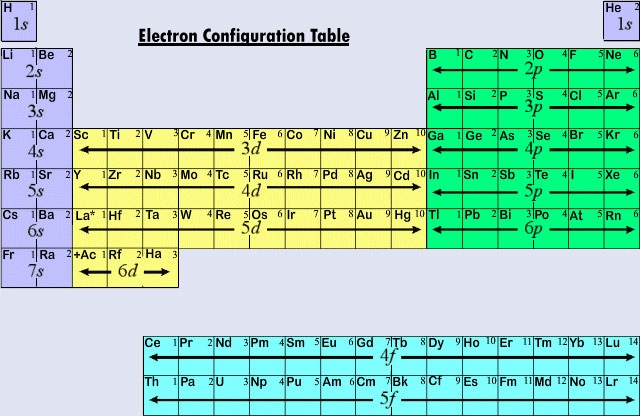
Considering the lanthanoids and most of the actinoids comport chemically as if they should fit in group IIIB of the periodic table (where Lu and Lr are found), both groups are separated from the residual of the table and placed together in a block beneath. Taken together, the lanthanoids and actinoids are called inner transition elements considering the f subshells being filled lie and then deep within the remaining electronic structure of their atoms.
Figure \(\PageIndex{two}\) summarizes the blazon of subshell in which the distinguishing electron is to exist plant for atoms of elements in various regions of the periodic table. This summary information makes it relatively uncomplicated to use the periodic table to obtain electron configurations, as the following example shows.
Obtain the electron configuration for (a) Nb; (b) Pr.
Solution
a) Nb, element number 41, is establish in the fifth menstruation and in a region of the periodic table where a d subshell is filling (the second transition series). Moving astern (toward lower atomic numbers) through the periodic tabular array, the nearest noble gas is Kr, and so we utilize the Kr kernel:
Nb [Kr] _____
The next element subsequently 36K is 37Rb in which the 5s subshell is filling. Moving right 1 more than infinite, we come to 38Sr which has a fivesouth 2 pair. So far we have Nb [Kr] _____ 5south ii for the Nb configuration. We now move farther right into the ivd subshell region of the periodic table and count over three spaces (Y, Zr, Nb) to reach Nb. The total electron configuration is thus Nb [Kr]4d 3vs 2 (Note that the principal quantum number of the d subshell is iv ― one less than the number of the period. Also, if you await at the table of electron configurations, it should be noted that Nb is an exception to the typical orbital filling rules) b) A similar procedure is followed for Pr, element number 59. Moving astern through the tabular array, the nearest noble gas is Xe, so we use the Xe kernel. Counting forwards again, Cs and Ba correspond to 6s 2. Then La, Ce, and Pr correspond to iii more electrons in the 4f subshell. The configuration is thus Pr ... [Xe]fourf 36s 2
One more point needs to exist emphasized nigh the relationship between electron configuration and the periodic table. The atoms of elements in the same vertical cavalcade of the table take similar electron configurations. For instance, consider the alkali metal-world elements (grouping IIA). Using our rules for deriving electron configurations (Case 1) we have
| Element | Electron Configuration | Lewis Diagram |
|---|---|---|
| Be | [He]2southward ii | Exist: |
| Mg | [Ne]3s 2 | Mg: |
| Ca | [Ar]4s 2 | Ca: |
| Sr | [Kr]5s two | Sr: |
| Ba | [Xe]sixs 2 | Ba: |
| Ra | [Rn]sevendue south 2 | Ra: |
Thus the similarities of chemical behavior and valence noted before for these elements correlate with the similarities of their outermost electron clouds. Such similarities account for the success of Mendeleev'southward predictions of the properties of undiscovered elements.

Electron Configuration Ending In S2d2,
Source: https://chem.libretexts.org/Bookshelves/General_Chemistry/Book%3A_ChemPRIME_(Moore_et_al.)/05%3A_The_Electronic_Structure_of_Atoms/5.17%3A_Electron_Configurations_and_the_Periodic_Table
Posted by: joneshaters.blogspot.com
0 Response to "Electron Configuration Ending In S2d2"
Post a Comment