

8 4/7 Divided By 15
Dividing Fractions
We will discuss here about dividing fractions by a whole number, past a fractional number or by another mixed partial number.
Commencement let united states recall how to find reciprocal of a fraction, we interchange the numerator and the denominator.
| For case, the reciprocal of ¾ is four/3. | |

Discover the reciprocal of iii ¾
| The reciprocal of 3 ¾ is iv/15. | |

I. Partitioning of a Fraction past a Whole Number:
4 ÷ two = ii ways, there are 2 2'due south in 4.
6 ÷ two = iii means, there are two 2's in 6.
Similarly 5 ÷ \(\frac{1}{two}\) means, how many halves are there in five?
We know that \(\frac{1}{2}\) + \(\frac{1}{ii}\) = one
| \(\frac{1}{two}\) + \(\frac{1}{2}\)+ | \(\frac{1}{2}\) + \(\frac{one}{2}\)+ | \(\frac{one}{ii}\) + \(\frac{1}{2}\)+ | \(\frac{1}{two}\) + \(\frac{1}{2}\)+ | \(\frac{ane}{2}\) + \(\frac{ane}{2}\) | |
| 1+ | 1+ | 1+ | 1+ | i | = 5 |
i.e. there are 10 halves in 5.
5 ÷ \(\frac{i}{2}\) = 5 × \(\frac{2}{1}\) = \(\frac{10}{ane}\) = 10
For Case:
i. \(\frac{seven}{ten}\) ÷ 5 = \(\frac{7}{10}\) ÷ \(\frac{5}{1}\)
= \(\frac{7}{10}\) × \(\frac{one}{5}\)
= \(\frac{vii × ane}{ten × v}\)
= \(\frac{7}{50}\)
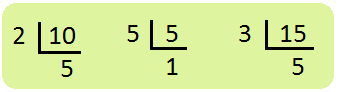
| 2. What is \(\frac{10}{15}\) ÷ 5? \(\frac{10}{15}\) ÷ \(\frac{5}{1}\) = \(\frac{ten}{15}\) × \(\frac{i}{5}\) = \(\frac{2 × \not 5 × one}{3 × \non five × 5}\) = \(\frac{ii}{15}\) | 10 = 2 × 5 15 = three × v 5 = 1 × 5 |
To separate a fraction past a number, multiply the fraction with the reciprocal of the number.
For example:
iii. Divide iii/5 by 12
| Solution: 3/5 ÷ 12 = 3/5 ÷ 12/1 = three/5 × 1/12 = (3 × ane)/(5 × 12) = 3/60 = 1/20 | Step I: Notice the reciprocal of the whole number and multiply with the partial number as usual. Pace II: Limited the product in its lowest terms. |
iv. Solve: 5/7 ÷ ten
| = 5/7 ÷ ten/one = 5/7 × 1/10 = (5 × 1)/(7 × 10) = 5/70 | Step I: Find the reciprocal of the whole number and multiply with the partial number as usual. Pace II: Express the product in its everyman terms. |
2. Division of a Fractional Number by a Fractional Number:
For instance:
1. Split 7/8 by 1/5
| Solution: 7/8 ÷ ane/5 = seven/8 × 5/1 = (seven × 5)/(8 × 1) = 35/8 = four three/eight | Stride I: Notice reciprocal of 1/5. Step II: Multiply 7/8 by it. Step Iii: Express the product in its simplest form. |
2. Carve up: v/ix ÷ 10/18
| Solution: 5/9 ÷ 10/xviii = five/9 × 18/ten = (five × xviii)/(9 × 10) = 90/xc = ane | Step I: Find reciprocal of 1/5. Step II: Multiply 7/8 by it. Stride III: Express the product in its simplest form. |
Segmentation of a Fraction by a Fraction:
three. Split \(\frac{3}{4}\) ÷ \(\frac{5}{3}\)
Stride I: Multiply the showtime fraction with the reciprocal of the second fraction.
Reciprocal of \(\frac{5}{3}\) = \(\frac{iii}{5}\)
Therefore, \(\frac{three}{4}\) ÷ \(\frac{five}{3}\) = \(\frac{3}{iv}\) × \(\frac{iii}{5}\)
= \(\frac{3 × 3}{iv × 5}\)
= \(\frac{9}{20}\)
Step Two: Reduce the fraction to the everyman terms. (if necessary)
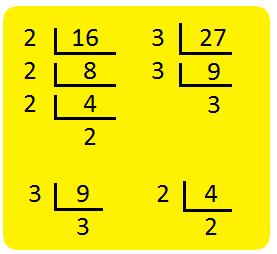
| 4. Divide \(\frac{16}{27}\) ÷ \(\frac{4}{9}\) Therefore, \(\frac{xvi}{27}\) ÷ \(\frac{4}{ix}\) = \(\frac{xvi}{27}\) × \(\frac{9}{iv}\); [Reciprocal of \(\frac{4}{9}\) = \(\frac{9}{4}\)] = \(\frac{\not two × \not ii × 2 × 2 × \not 3 × \non iii}{\not 3 × \not 3 × 3 × \non 2 × \not 2}\) = \(\frac{four}{iii}\) = 1\(\frac{1}{3}\) | sixteen = 2 × 2 × two × two 9 = iii × 3 27 = 3 × 3 × three 4 = ii × 2 |
Iii. Division of a Mixed Number past another Mixed Number:
For example:
ane. Carve up 2 ¾ by 1 2/iii
| Solution: two ¾ ÷ i 2/3 = 11/4 ÷ five/3 = 11/four × 3/5 = (11 × 3)/(4 × 5) = 33/20 = one thirteen/20 | Express the mixed numbers as improper fractions and multiply every bit usual. |
2. Divide: 2 4/17 ÷ 1 four/17
| Solution: two 4/17 ÷ one 4/17 = 38/17 ÷ 21/17 = 38/17 × 17/21 = (38 × 17)/(17 × 21) = 646/357 = 38/21 = 1 17/21 | Express the mixed numbers as improper fractions and multiply as usual. |
Questions and Answers on Dividing Fractions:
I. Divide the post-obit.
(i) \(\frac{2}{half-dozen}\) ÷ \(\frac{1}{3}\)
(ii) \(\frac{5}{8}\) ÷ \(\frac{15}{16}\)
(iii) \(\frac{5}{half-dozen}\) ÷ 15
(iv) \(\frac{7}{viii}\) ÷ 14
(v) \(\frac{2}{iii}\) ÷ 6
(half dozen) 28 ÷ \(\frac{7}{iv}\)
(vii) 2\(\frac{5}{six}\) ÷ 34
(eight) 9\(\frac{ane}{2}\) ÷ \(\frac{38}{2}\)
(9) three\(\frac{1}{iv}\) ÷ \(\frac{26}{28}\)
(x) 7\(\frac{1}{iii}\) ÷ 1\(\frac{5}{6}\)
(xi) 2\(\frac{3}{5}\) ÷ ane\(\frac{11}{15}\)
(xii) 1\(\frac{ane}{2}\) ÷ \(\frac{4}{7}\)
Related Concept
● Fraction of a Whole Numbers
● Representation of a Fraction
● Equivalent Fractions
● Properties of Equivalent Fractions
● Like and Unlike Fractions
● Comparison of Like Fractions
● Comparing of Fractions having the aforementioned Numerator
● Types of Fractions
● Changing Fractions
● Conversion of Fractions into Fractions having Same Denominator
● Conversion of a Fraction into its Smallest and Simplest Class
● Improver of Fractions having the Same Denominator
● Subtraction of Fractions having the Aforementioned Denominator
● Improver and Subtraction of Fractions on the Fraction Number Line
fourth Course Math Activities
From Dividing Fractions to Dwelling PAGE
Didn't find what you lot were looking for? Or want to know more data about Math Only Math. Use this Google Search to find what you lot need.

8 4/7 Divided By 15,
Source: https://www.math-only-math.com/dividing-fractions.html
Posted by: joneshaters.blogspot.com
0 Response to "8 4/7 Divided By 15"
Post a Comment